

P-TREX P is the line of pultruded profiles made of composite material – FRP. They are available in more than 200 sections and in many different materials and colours.

P-TREX G is the line of gratings in composite material – GRFP. Available in different sizes, thicknesses and mesh size.

P-TREX S structures are made by FRP, the best and cost-effective material to face demanding industrial applications and environmental conditions.

P-TREX F fences and gates are the most innovative systems to fence and protect those areas where electrical insulation, amagnetic and chemical resistance are required.

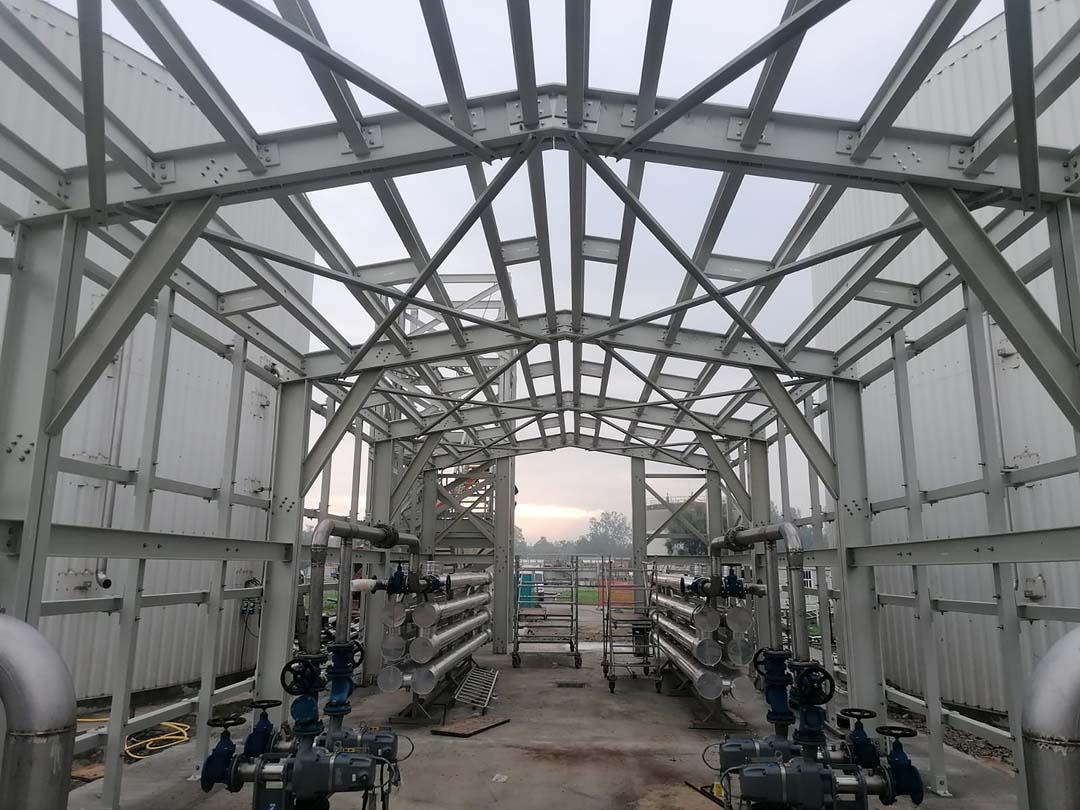
One of the most recent projects, unique in its kind at the national level for its size and innovation, involves an impressive structure entirely developed in GFRP. It includes a complex of stairs, walkways, and a structure used as a technical room. Commissioned by a major local water management entity, IRETI S.p.A., this project is designed for a specific site called P.A.D, Parco Acque Depurate, which hosts the Mancasale wastewater treatment plant, the first in Emilia-Romagna for advanced tertiary treatment of wastewater: an open-air experimental research center dedicated to the reuse of treated water in agriculture.
The design and construction of this project effectively addressed five design challenges:
We are pleased to share the technical contribution of Engineer Francesco Masetti, Head of Works Management Networks and Plants, Reggio Emilia area, at IRETI S.p.A.
“The intervention in question,” says Engineer Francesco Masetti, “concerns the complete renewal of the second of three anaerobic digestion lines at the Mancasale (RE) wastewater treatment plant. This plant is the largest in the province of Reggio Emilia, with a capacity of about 250,000 PE and a basin that includes three-quarters of the capital city as well as the municipalities of Albinea and Bagnolo.
From the outset, the digestion line refurbishment project was characterized by a strong innovative drive, aimed at maximizing the functionality of the new plant and its long-term durability. For this reason, vitrified steel was chosen as the material for constructing the two new anaerobic digesters, replacing the previous ones built in the mid-1990s in in-situ reinforced concrete.
The project, in addition to constructing the tanks, also included a series of accessory structures critical for proper process management: the room housing all electromechanical equipment for mixing the sludge and the stairs to access the tops of the tanks.
The structures consist of:
The reasons driving the project from its inception naturally led to the choice of pultruded GFRP elements, thanks to their durability, especially in a high-performance context such as a wastewater treatment plant.
While the choice of material was relatively straightforward, it was more complex to identify a supplier that could guarantee not only the production of the material within the project’s specifications and deadlines but also its internal engineering for designing structures made of a material that, due to its innovative nature, is challenging for structural engineers. P-TREX’s contribution in this regard was fundamental, forming a true partnership in realizing the project.
The continuous exchange between P-TREX’s design staff and IRETI’s implementation team was constant, with the common goal of obtaining the necessary authorizations, navigating an uncharted “territory,” and overcoming the skepticism of some traditionally minded engineers. The joint effort and considerable professional expertise were crucial to successfully completing the authorization process, enabling the realization of what, for those involved, is much more than just a project or construction site.”
Watch the video of this project:
https://youtu.be/r8xoCsdfRHU
GFRP: The Material of the Future for Innovative Designers
P-TREX’s GFRP is a composite material increasingly in demand for infrastructure projects due to its corrosion resistance, lightness, and ease of installation. Ideal for designers aiming for sustainability and superior technical performance, GFRP stands out for its ability to reduce maintenance costs and extend the useful life of structures. This makes it a winning long-term choice for durable, low-environmental-impact works.
EPD: A Key Certification for Sustainable Design
The Environmental Product Declaration (EPD) of Fibre Net products ensures the transparency and sustainability of material life cycles; it is an essential tool for designers choosing solutions that reduce environmental impact, improve performance, and comply with the most stringent regulations.
The EPD certifies that the products meet international standards and can be used in projects requiring compliance with CAM, ensuring access to public tenders and funding where sustainability is a priority.
CAM is now a fundamental element in the design and construction processes, especially for public works.
Thanks to the EPD, P-TREX GFRP products meet these criteria, making them a strategic choice for designers aiming to create sustainable and innovative works.
P-TREX GFRP Solutions Offer: